| |
2026MY Certification Reminders, Right to Repair, PFAS Compliance, State Business License Requirements, Engine Weight Updates, Boating Safety Circular, Q&A
|
| |
|
|
| |
|
| |
NMMA Certification Deadlines—2026 Model Year: REMINDERS
The NMMA Engineering team is dedicated to product safety and supporting our members as they work towards achieving certification.
Below are the upcoming deadlines for completing certification for the 2026MY. Please ensure all requirements are fulfilled by the date noted below:
- Variations Responses: within 30 days of report date/120-day max with a requested extension.
- Exams must be completed by June 30 of the new model year.
- Get a head start on 2027MY by signing your annual agreement. 2027MY agreements were sent out via DocuSign
Please log into the NMMA ECT portal here to review the certification checklist to monitor your progress.
Exams are available to all participating manufacturers’ employees. To register for the annual exams, please reach out to Melissa Taylor at [email protected].
Please contact Lucyna Koscielniak at [email protected] or Chad Keskitalo at [email protected] with any questions.
|
| |
|
| |
Digital Right to Repair Act—Alaska HB 162
The Digital Right to Repair Act in Alaska is a legislative effort designed to empower consumers and independent repair businesses by requiring manufacturers of digital electronic products ranging from cell phones to farm machinery to provide access to necessary repair parts, tools, and documentation. Aimed at reducing electronic waste and overcoming prohibitively high costs of authorized dealer repairs, the act mandates that companies sell these materials on fair and reasonable terms directly to consumers and local repair shops.
Right‑to‑Repair legislation continues to advance at the state level serving as a key example of how these proposals may affect the recreational boating industry. While the Alaska bill has not yet been enacted, it has been actively moving through the legislative process and is receiving increasing attention from policymakers and stakeholders. NMMA, in coordination with MRAA, has taken an active role in opposing the current Alaska proposal. This includes the submission of a formal letter of opposition to the Alaska House Community & Regional Affairs Committee and direct engagement with legislators.
Recent Updates:
Following a hearing held on April 21, 2026, the Alaska House Community and Regional Affairs Committee advanced HB 162 with five adopted amendments. The bill now moves to the Alaska House Labor and Commerce Committee. A hearing has not been scheduled.
The following is a detailed breakdown of the amendments and their implications, along with recommended next steps:
Summary of Adopted Amendments and Impacts:
- Amendment 1—Contractual Clarification (Technical Fix)
Clarifies that only the specific provision of a contract that violates the statute is void, rather than the entire agreement.
- Impact: Minimal substantive impact. Provides legal clarity but does not change compliance obligations.
- Amendment 2—Critical Infrastructure Exemption
Adds an exemption for “critical infrastructure” as defined under Alaska statute.
Impact:
- Unlikely to apply to recreational marine products
- Does not address emissions-related concerns
- Amendment 7—Parts Pairing Permitted
Removes the prohibition on parts pairing, allowing manufacturers to continue using serialized or software-linked components.
Impact:
- Significant improvement for manufacturers
- Preserves system integrity, safety, and OEM business models
- Reduces risk of incompatible or unsafe repairs
- Amendment 8—ost Recovery for Tools and Software
Removes the requirement that tools and software be provided “without charge.”
Impact:
- Allows manufacturers to recover costs associated with software, diagnostics, and distribution
- Still requires access, which remains a concern for emissions-related systems
- Amendment 10—Delayed Effective Date (Revised to 2029)
Extends implementation timeline from 2027 to 2029.
Impact:
- Provides additional runway for compliance planning
- Acknowledges complexity of implementation
- Does not resolve underlying policy concerns
Next Steps:
- Boating United Alert: We will send an alert to members of the Alaska House Labor and Commerce Committee urging opposition to HB 162 as amended and reinforcing our federal compliance and safety concerns.
- Coalition Coordination: Continue alignment with partners to ensure consistent messaging.
- Amendment Strategy: Evaluate opportunities to narrow scope or secure explicit protections for emissions-regulated systems in the next committee.
- Timing Considerations: The Alaska legislative session is scheduled to adjourn on May 20, which creates a compressed timeline for engagement and increases the importance of immediate outreach.
|
| |
|
| |
PFAS Compliance
PFAS (per- and polyfluoroalkyl substances) regulations continue to be a growing area of concern for boat builders, with increasing attention at both the state and federal levels. Following a recent PFAS webinar, several builders have asked for clearer guidance on what concrete steps they should be taking today, as opposed to longer‑term planning for future regulations.
At this stage, PFAS requirements and restrictions vary by state, product type, and application, and many rules are still evolving. As a result, there is no single, uniform compliance approach that applies across all geographies or products. However, regulators are clearly moving toward greater scrutiny of PFAS use, particularly in materials, coatings, components, and supply chains.
The key challenge for builders is balancing preparedness with uncertainty. While it may be premature to make sweeping product or material changes in the absence of finalized rules, doing nothing carries its own risk, especially where PFAS-containing materials are used routinely and supplier transparency is limited.
What builders should be doing now:
- Maintain general awareness of where PFAS may exist in materials, components, or manufacturing processes.
- Engage with suppliers to better understand material composition and available alternatives.
- Document materials and uses so information is readily available as regulations advance.
- Monitor state‑level developments closely, as requirements may emerge unevenly across jurisdictions.
NMMA will continue to track PFAS regulatory developments, share updates as rules become clearer, and provide guidance to help builders prioritize actions without over or underreacting in a rapidly evolving regulatory environment.
Minnesota PFAS Updates:
Minnesota’s PFAS reporting rule, established in 2023 under Amara’s Law, is widely considered the most stringent in the United States and will create significant compliance challenges for recreational boat builders and marine manufacturers, many of which are small businesses.
More information on Minnesota’s PFAS Reporting Rule can be found here.
|
| |
|
| |
State by State Business Licensing
Boat builders are increasingly encountering state‑specific business licensing and registration requirements that can delay or block sales, even without a physical presence in the state. Recent builder experience highlights that some states may require executive‑level applications, fingerprinting, and extended approval timelines, resulting in lost sales opportunities. Requirements vary widely by state and product type (particularly for trailers) making early awareness and planning essential.
Checklist: Before Entering a New State Market
Before committing to sales in a new state, builders should consider:
- Product scope:
- Are trailers, auxiliary equipment, or other regulated products included?
- Business licensing:
- Does the state require a license or registration to sell without in‑state facilities?
- Are requirements different for manufacturers vs. distributors?
- Application burden:
- Are fingerprints, background checks, or notarized documents required?
- Is executive or owner involvement required?
- Timing considerations:
- What is the typical approval timeline (weeks vs. months)?
- Can sales occur while an application is pending?
- Resource planning:
- Who internally owns the application and follow-up?
- Are sensitive personal documents readily available if needed?
- Early escalation:
- Raise potential barriers early with NMMA or industry counsel
- Flag issues before quoting customers or confirming delivery dates
Administrative licensing requirements are becoming a more common and impactful constraint on market expansion. Factoring licensing diligence into early sales planning can help builders avoid delays, lost orders, and unnecessary executive distraction.
|
| |
|
| |
ABYC—Boat Capacity—Outboard Engine Weight Updates
The upcoming ABYC supplement 66 introduces revised requirements for determining and displaying outboard engine weights on boat capacity labels. Some of the key changes are summarized below.
Boats less than 20':
For boats less than 20 ft (6.1 m) in length, the maximum persons capacity, in pounds, shall not exceed the maximum weight capacity, less the total weight from ABYC S-30, Outboard Engine and Related Equipment Weights TABLE 1, or actual weight, whichever is greater, for the boat’s horsepower capacity rating and, the ABYC S-30 running weight, or actual weight, whichever is greater, shall be displayed on the capacity label per ABYC S-7, Boat Capacity Labels
Pontoons less than 20':
For outboard powered pontoon boats with an outside pontoon length of less than 20 ft (6.1 m) the maximum persons capacity in pounds shall not exceed the maximum weight capacity less the total weight from ABYC S-30, Outboard Engine & Related Equipment Weights, or actual weight whichever is greater, and the ABYC S-30 running weight, or actual weight, whichever is greater, shall be displayed on the capacity label per ABYC S-7, Boat Capacity Labels
For pontoons and boats 20' and greater:
The heaviest outboard engine running weight as specified by the boat manufacturer shall be displayed on the capacity label per ABYC S-7, Boat Capacity Labels
New definition: Outboard Engine Running Weight—The weight of the engine in the ready to use condition that includes the engine dry weight, fluids, and heaviest recommended propeller(s) (see ABYC S-30, Outboard Engine and Related Engine Weights).
The updated standards are set to be published in July and once published can be applied starting August 1, 2026.
Proposed alternative U.S. Capacity Label design will be addressed in the July 2026 publication of ABYC S-7 Boat Capacity Labels.
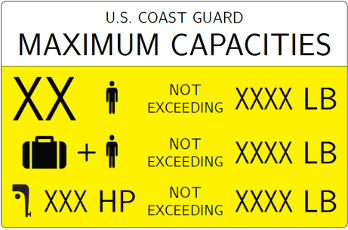
Example of proposed capacity label for outboard boat under 20':
|
| |
|
| |
USCG—Spring 2026 Boating Safety Circular
The Spring 2026 Boating Safety Circular is now available on our website, and includes articles/information on the following:
- Risk Mitigation Series 10
- Defect Notification Policy
- ABYC Technical Information Report for eFoils & Jetboards
- National Recreational Boating Safety Survey
- Compliance Inspectors
- Calendar of Events
- Websites and Email Addresses
- Boating Safety Circular Index
- Recalls
Circulars include important information from the Coast Guard for all recreational boat manufacturers. You can click here to download from the U.S. Coast Guard Office of Auxiliary & Boating Safety’s website.
|
| |
|
| |
Have questions about our certification programs? We have answers. Submit your questions to us at [email protected]. We’re happy to respond directly and may also feature your question in this bulletin to help others.
|
| |
|
| |
The Compliance Bulletin is an online newsletter published by the NMMA Engineering Standards Department. It addresses issues regarding compliance, industry news, new standards and the NMMA Certification Program. If there is someone you would like to add to this newsletter subscription, please contact Compliance Bulletin editor, Scott Berry at
[email protected].
To ensure delivery, please add [email protected] to your address book.
|
| |
|
|
|